Key Takeaways
TL;DR: Western North Carolina’s steep grades and heavy clay soil make slope erosion a real and costly problem for Buncombe County homeowners. Without proper stabilization, hillsides lose inches of topsoil each year, foundations shift, and drainage problems spiral. Native plantings, natural stone retaining walls, gravel channels, and strategic mulching are proven tools that stop erosion before it becomes a structural emergency.
- Buncombe County receives substantial annual rainfall, accelerating hillside erosion on unprotected slopes.
- Clay-heavy WNC soil becomes slick and unstable when saturated, making slope stabilization urgent, not optional.
- Native plants with deep root systems anchor soil far more effectively than turf grass on grades steeper than 3:1.
- Natural stone retaining walls and gravel-lined swales redirect water before it carves channels into your yard.
- Professional mulching to an appropriate depth can meaningfully slow runoff velocity on moderate slopes.
- Combining hardscape elements with biological plantings gives both short-term and long-term protection.
- Acting before a storm season is significantly less expensive than repairing a failed slope after the damage is done.
Why Slope Erosion in Asheville Is a Bigger Problem Than Most Homeowners Realize
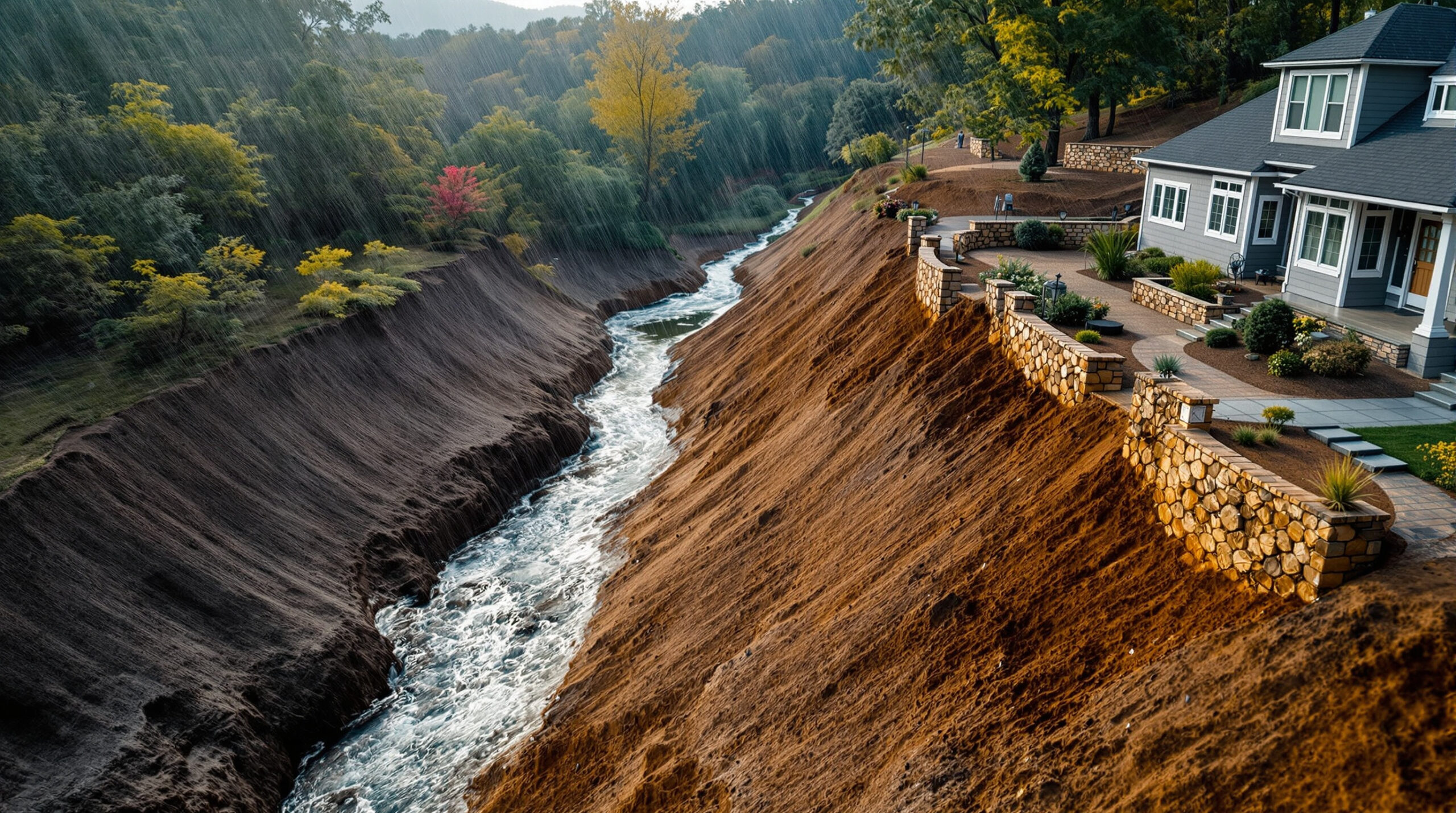
Slope erosion control in Asheville NC is urgent because the region’s combination of steep mountain grades, heavy annual rainfall, and dense clay soil creates erosion conditions that flat-terrain homeowners rarely encounter. Unprotected hillsides in Buncombe County can lose significant topsoil under heavy rain events, and once that soil moves, it takes vegetation, drainage capacity, and sometimes foundation integrity with it.
Most people notice the problem after a heavy storm when they see a muddy trail carved down the backyard hill or a pile of sediment building up near the foundation. By that point, the slope has already been eroding for seasons. The Appalachian topography around Asheville means that even modest backyards can include grades of 15 to 40 percent, grades where standard lawn grass simply cannot hold soil during a two-inch rain event. The region’s geology compounds the issue: the same granite-rich bedrock that makes Western North Carolina so beautiful also limits water infiltration in spots, forcing runoff to travel across the surface where it picks up speed and soil as it goes downhill.
Understanding the mechanics of erosion is the first step toward choosing the right combination of solutions. This article walks through how water moves on a WNC hillside, what plant and hardscape tools actually work, realistic cost ranges, and the steps a homeowner should take before the next storm season. Reems Creek Outdoors has worked with slopes across the Asheville area, Weaverville, Riceville, and Hendersonville, and the same core principles apply to nearly every hillside situation this region produces.
How Water Actually Moves on a Western North Carolina Hillside
Water moves on a WNC hillside by following the path of least resistance, accelerating as slope angle increases, and detaching soil particles that travel with it as suspended sediment. On a 20-percent grade, unprotected soil can experience sheet erosion, rill formation, and eventually gully cutting within a single storm season if no stabilization is in place.
What is sheet erosion and why does it go unnoticed for so long?
Sheet erosion is the thin, even removal of topsoil across a broad surface. It does not carve dramatic channels, so homeowners often miss it until they notice the subsoil layer, typically orange or gray clay in WNC, sitting exposed at the surface. Topsoil depths in Buncombe County vary considerably depending on site history and disturbance. Once that layer is gone, vegetation struggles to establish and the problem accelerates. Sheet erosion is most severe on slopes with no canopy cover and compacted soil, which describes many cleared residential lots in the Asheville area.
When does sheet erosion become rill and gully erosion?
Sheet flow concentrates into rills, small channels an inch or two deep, when water volume increases or surface irregularities redirect the flow. Rills become gullies when repeated storms deepen and widen those channels to more than 12 inches. At that point, basic mulching and seeding are no longer sufficient. Gullies require re-grading, structural check dams, or retaining wall segments before biological solutions can take hold. Rain events exceeding one inch per hour, which are common in WNC summer thunderstorms, can advance a slope from rill to gully stage in a single season. For federal guidance on erosion control standards, consult resources from the EPA or the USDA Natural Resources Conservation Service (NRCS).
How does clay soil make WNC slopes different from other regions?
Clay soil absorbs water slowly and becomes almost impermeable when compacted. On a steep slope, this means rainfall that cannot infiltrate runs off immediately, carrying soil with it. WNC clay also swells when wet and shrinks when dry, creating a freeze-thaw cycle that loosens soil particles and makes them easier to detach on the next rain event. This is why slopes in Asheville behave differently from slopes in the Piedmont or coastal regions where sandy-loam soils allow faster infiltration. Any erosion control plan for this area must account for the clay layer beneath the surface topsoil. Homeowners dealing with these conditions may also benefit from reviewing drainage solutions for sloped mountain property in Asheville NC to address how water is managed across the full landscape.
Native Plants That Actually Anchor WNC Hillsides
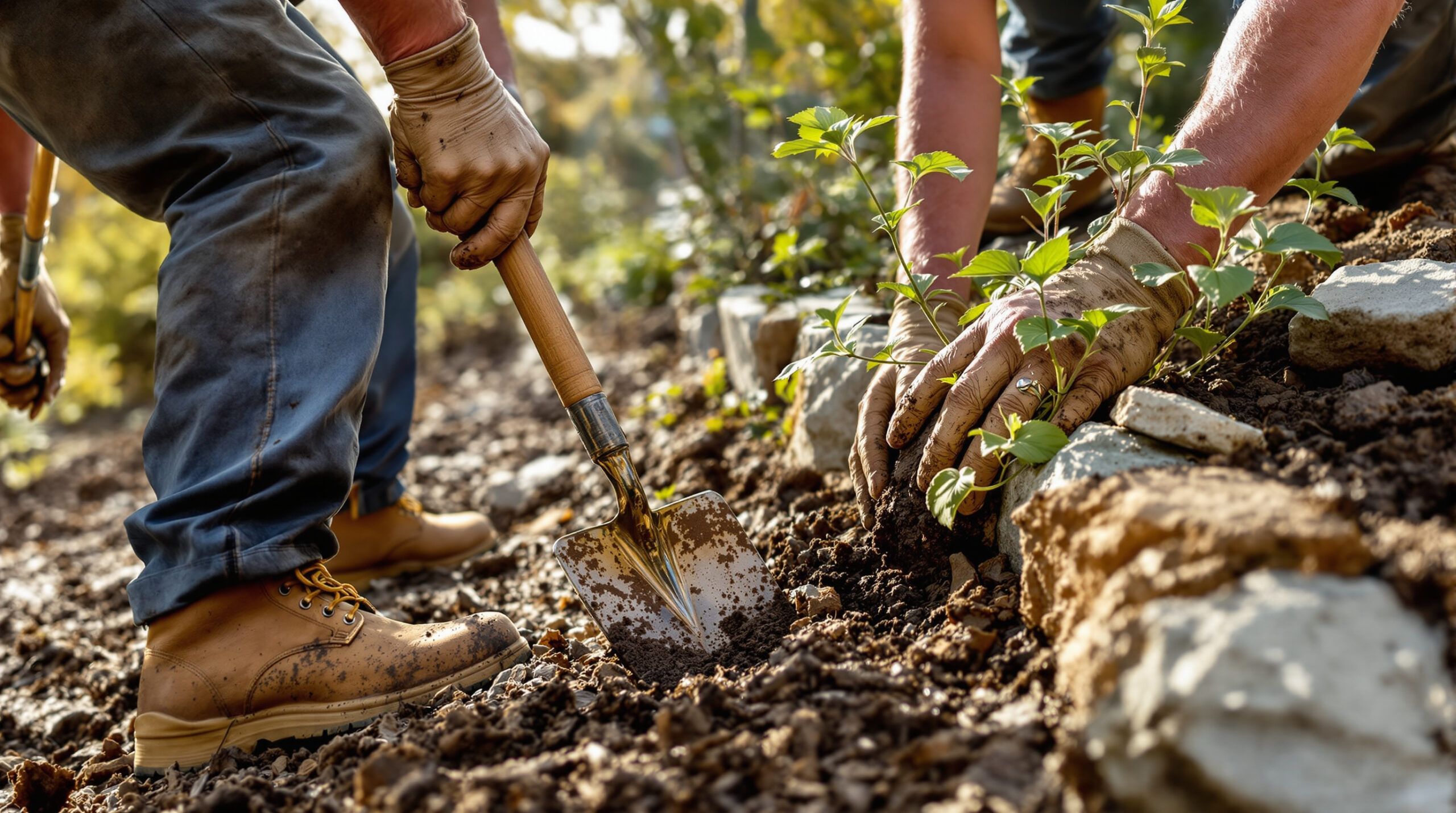
Native plants with deep, fibrous root systems are the most durable long-term solution for slope erosion control in Asheville NC, because their roots physically bind soil particles together and their canopy intercepts rainfall before it hits bare ground. Native species are adapted to WNC’s rainfall patterns and require far less maintenance than non-native ground covers once established. Additional information on native plant ecosystems is available through the USDA PLANTS Database and NC State Extension.
Which native plants work best on steep Asheville-area slopes?
Several species perform consistently well on WNC hillsides. Switchgrass (Panicum virgatum) reaches 3 to 5 feet and develops notably deep root systems, making it one of the most effective soil anchors available. Eastern red columbine (Aquilegia canadensis) handles rocky, partially shaded slopes common on north-facing hillsides in Buncombe County. Wild ginger (Asarum canadense) spreads as a dense ground cover that suppresses weeds and holds moisture in the soil. River birch (Betula nigra) works on wetter slopes and creek margins, sending roots laterally to bind riparian edges. Wild bergamot (Monarda fistulosa) handles sun-exposed slopes and attracts pollinators as a secondary benefit. For a deeper look at species that thrive in the region’s shadier conditions, the guide to shade tolerant native plants for Asheville NC landscaping covers many of the same hillside environments. Native species generally establish faster than ornamentals on disturbed slopes because they are already adapted to local soil chemistry and seasonal moisture patterns, meaning plantings work with the site rather than against it.
How long does it take native plantings to stabilize a slope?
Most native ground covers and grasses show meaningful root development within 6 to 12 months and reach functional erosion-control density within 18 to 24 months. During that establishment window, a slope is still vulnerable, which is why temporary erosion control measures like jute mesh, straw wattles, or mulch must be used simultaneously. Jute biodegradable mesh is particularly effective on slopes up to 50 percent grade; costs vary depending on material quality, slope complexity, and installation requirements. It breaks down as plants establish, eliminating removal costs.
What about non-native options like kudzu or English ivy?
Invasive non-native plants like kudzu, English ivy, and Japanese honeysuckle are sometimes marketed as low-cost erosion solutions. They do hold soil in the short term, but they outcompete native species, alter soil chemistry, and eventually require expensive removal. North Carolina law classifies several of these species as invasive pests. Any short-term erosion benefit is outweighed by the long-term ecological and maintenance cost. Native alternatives almost always deliver better outcomes over a 5 to 10 year window. Learn more about invasive species management at Wikipedia’s article on invasive species.
Retaining Walls and Hardscape Elements That Stop Slope Failure
Retaining walls and hardscape elements stop slope failure by interrupting the flow of both water and soil, creating level terraces that reduce effective slope angle and give plantings a stable platform to establish. For grades above 25 percent or slopes longer than 30 feet, hardscape elements are typically necessary alongside biological solutions, not optional additions. Homeowners exploring their full range of options should look at hardscaping ideas for a sloped backyard in Western NC to understand how walls, steps, and terracing work together. For technical standards on slope stabilization, see resources from the USDA Natural Resources Conservation Service (NRCS) or your local Cooperative Extension office.