Key Takeaways
TL;DR: A permeable gravel patio manages stormwater by letting rain soak through instead of running off your property. On Asheville’s steep, clay-heavy lots, that difference matters. Gravel patios cost less than poured concrete, install faster, and handle freeze-thaw cycles without cracking. Done right, they look great and work hard for years.
- Permeable gravel allows rainwater to filter into the ground rather than sheet across slopes and erode soil.
- Western North Carolina’s clay soil and steep grades make standard impervious hardscaping a runoff risk.
- Properly installed gravel patios use layered base material to maintain stability and drainage long-term.
- Gravel options range from crushed granite to river rock, each with different drainage rates and aesthetics.
- Reems Creek Outdoors installs permeable gravel patios and driveways for homeowners across Asheville and the surrounding area.
Why Permeable Gravel Patios Make Sense on Asheville Properties
A permeable gravel patio lets rainwater pass through the surface and into the ground below instead of pooling or running downhill, which directly reduces erosion and stormwater runoff on steep Western North Carolina lots. That single function solves problems that plague concrete and paver installations on slopes. Asheville sits in a region where annual rainfall averages around 47 inches per year, and a lot of that rain falls fast during summer storm events. When water hits an impervious surface on a graded lot, it accelerates. It picks up soil, undercuts beds, floods low spots, and eventually damages foundations. Gravel stops that cycle before it starts. The water goes down, not sideways. For homeowners who have watched mulch wash out of beds or seen muddy channels carve through their yard after every hard rain, a permeable gravel patio is not just a nice-to-have. It is a practical drainage solution that also gives you usable outdoor space. Learn more about stormwater management best practices from the EPA.
How Gravel Patio Installation Actually Works
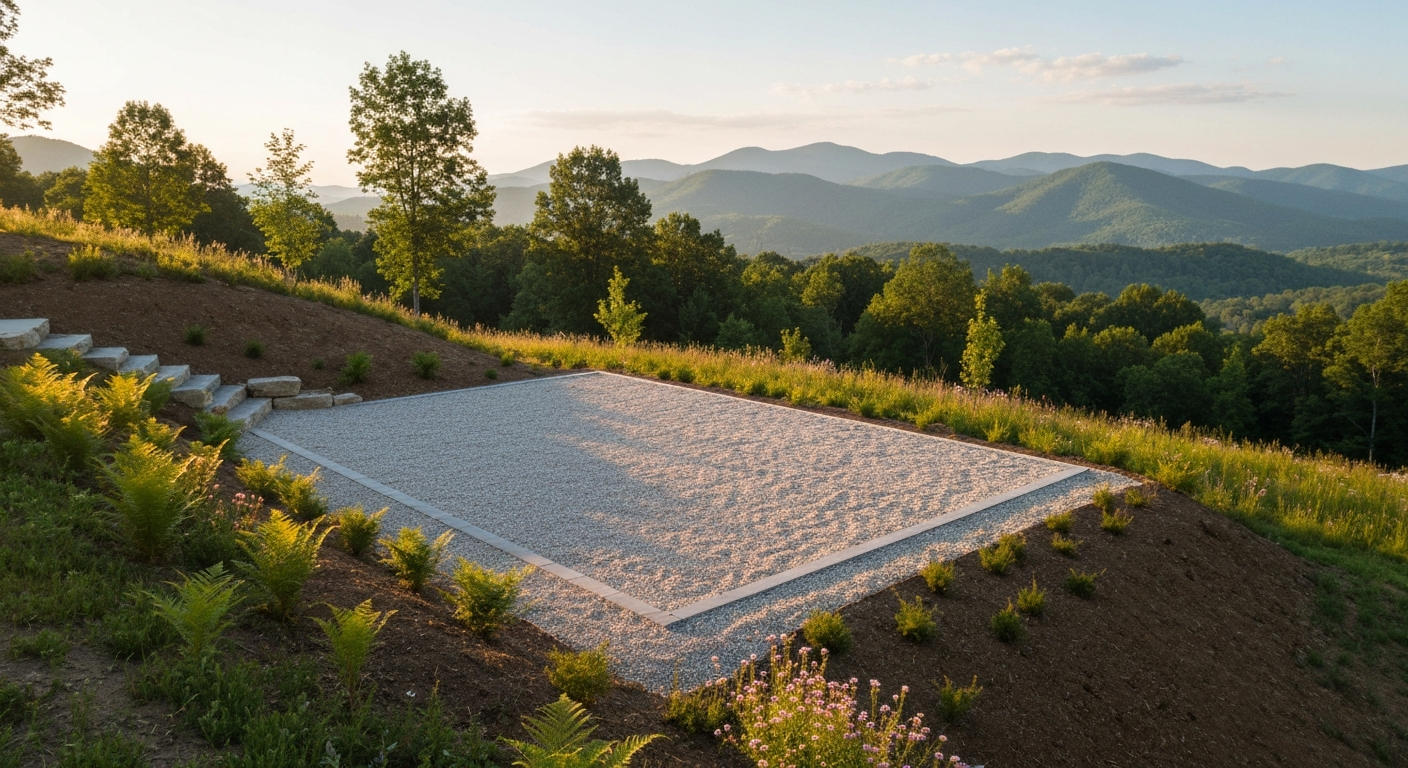
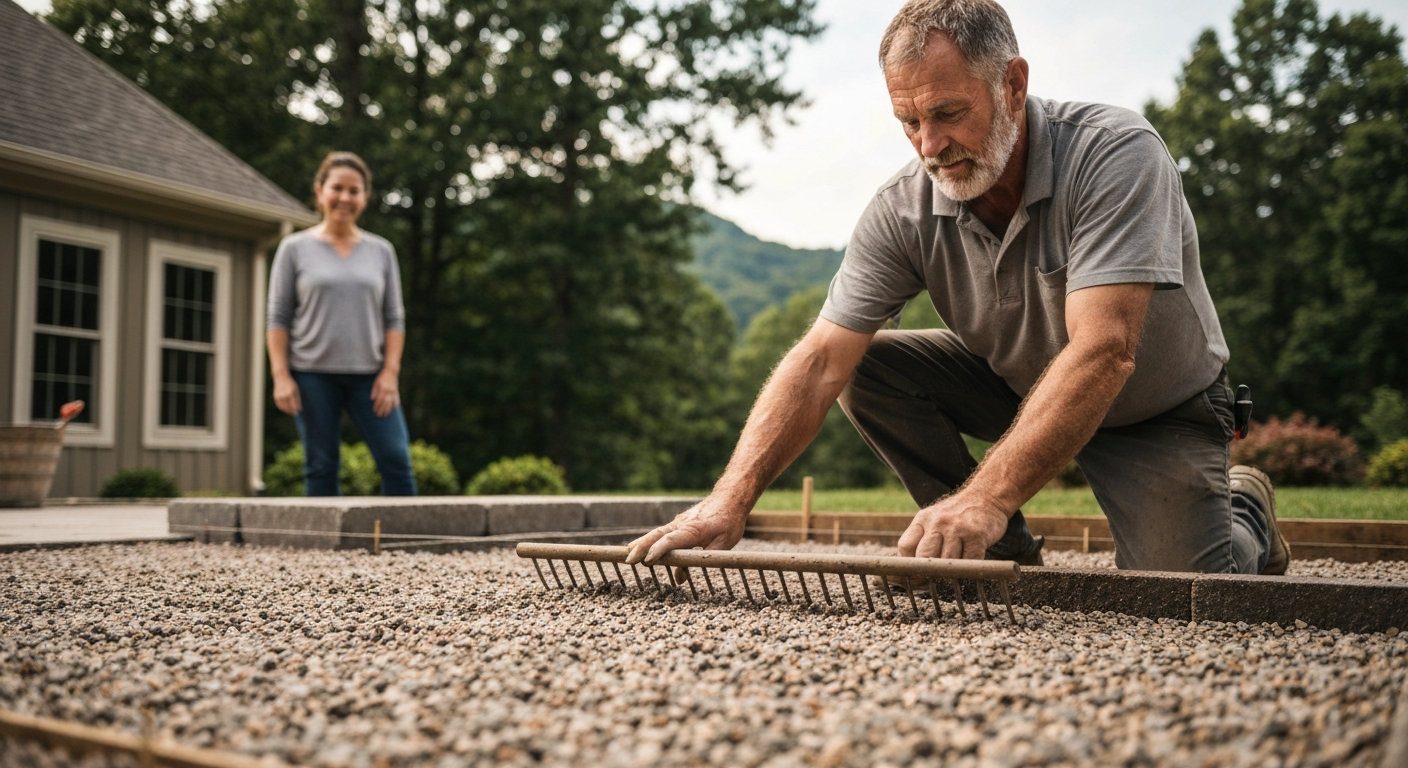
The finished surface of a gravel patio is only part of the story. What goes underneath determines whether it stays stable, drains consistently, and holds its shape after a hundred rain events. A properly built permeable gravel patio starts with excavation, typically four to six inches deep depending on the site and anticipated load. After excavation, the crew installs a layer of compacted crushed stone base material, often 3/4-inch clean stone or a road base aggregate, that creates both structural support and a drainage reservoir. A permeable landscape fabric goes between the base layer and the finished surface gravel to separate materials without blocking water flow. The top layer is usually a finer decorative aggregate like pea gravel, crushed granite, or decomposed granite, depending on the look a homeowner wants. Edge restraints, typically steel, aluminum, or stone banding, hold everything in place and keep the gravel from migrating into surrounding beds. On sloped Asheville lots, the crew may also cut the site level in sections or install a French drain alongside the patio to handle overflow during extreme rain events. Homeowners dealing with hardscaping on a sloped backyard often find that gravel paired with proper sub-base preparation outperforms rigid surface materials over the long run. According to the American Society of Landscape Architects, proper sub-base preparation accounts for the majority of a permeable hardscape installation’s long-term performance. Skipping layers to save money upfront almost always leads to settling, ruts, and washout within a few seasons.
Gravel Options and What They Mean for Your Yard
Not all gravel performs the same way, and the choice of material affects both drainage and how the finished patio looks and feels underfoot. Crushed granite is one of the most popular choices in the Asheville area. It compacts lightly over time into a firm walking surface while still allowing water infiltration. The angular edges of crushed stone lock together better than round stone, which means less shifting underfoot. Pea gravel is smooth and rounded, giving a softer, more relaxed look, but it moves more easily and may need occasional redistribution. Decomposed granite offers a fine, almost sandy texture that compacts well and works especially well for patios adjacent to naturalistic garden beds. River rock, in larger sizes, works well for accent borders but is not ideal as a primary patio surface since round stones shift under foot traffic.
Matching Gravel to Your Landscape Style
Crushed granite in buff or gray tones reads as clean and contemporary. River rock in warm tans and browns fits a more naturalistic, mountain-cottage style. Decomposed granite in gold or rust tones pairs well with native plantings and flagstone or slate accents. Reems Creek Outdoors helps homeowners in Asheville and the surrounding region match gravel type to their existing landscape so the finished space looks intentional rather than improvised. As landscape designer and author Julie Moir Messervy notes, “The materials you choose for an outdoor space communicate the character of the entire garden. Gravel that fits the site’s geology and plant palette will always look more natural than something imported for its own sake.” That principle holds especially true in Western North Carolina, where the local stone palette runs toward gray granites, blue-gray slate, and warm river cobbles.
Gravel vs. Concrete: A Straightforward Comparison for WNC Homeowners
Homeowners often weigh gravel against poured concrete when planning a patio or driveway. Concrete is familiar, but it comes with real drawbacks in mountain terrain. Concrete is impervious, meaning all water that hits it becomes runoff. On a sloped lot, that runoff has to go somewhere, and it usually goes somewhere you do not want it. Concrete also cracks. Western North Carolina’s freeze-thaw cycles, with repeated freezing and thawing through winter months, expand water in any sub-base voids and cause concrete to heave and fracture. Repair is expensive and visible. Gravel does not crack. It shifts slightly but can be raked back into place. It drains. It costs significantly less per square foot to install, with typical gravel patio installations running $3 to $7 per square foot for materials compared to $6 to $12 for standard poured concrete. For a fuller breakdown of how material and labor costs compare across approaches, the guide on slope landscaping costs for professional vs. DIY projects in Asheville is worth reviewing before committing to a budget. Permeable pavers fall in between on cost but share many of the drainage benefits of gravel. Research on permeable surface materials shows they reduce peak stormwater runoff volume by 80 to 90 percent compared to equivalent impervious surfaces. Learn more about environmental health and stormwater research through the NIH. On a residential lot in Asheville that already struggles with erosion, that number is hard to argue with. If you are wondering what to ask before committing to any hardscaping contractor, check out this guide on landscape contractor questions in Asheville for a straightforward list of what matters. And if you are planning to bring a contractor onto your property for the first time, the resource on hiring a landscape contractor in Asheville NC walks through what to expect from the process. One often-overlooked detail: gravel works well around utility boxes and meters where other hardscaping materials create access problems. For ideas on handling those spots, see the post on landscaping around utility boxes and meters.
Frequently Asked Questions
What makes a gravel patio permeable compared to other patio materials?
Gravel is permeable because the spaces between individual stones allow water to pass through the surface and into the ground below. Unlike poured concrete or solid paver systems, gravel does not form an impervious barrier. When installed over a properly compacted and drained sub-base, a gravel patio can absorb and filter rainwater at the point where it lands rather than directing it off-site as runoff. For more information on water infiltration and soil science, visit Wikipedia’s resource on infiltration hydrology.
How long does a properly installed gravel patio last in Asheville’s climate?
A gravel patio installed with proper base preparation, edge restraints, and appropriate fabric separation can last 15 to 20 years or more with basic maintenance. The Asheville area’s freeze-thaw cycles and heavy summer rainfall are less damaging to gravel than to concrete or rigid pavers because gravel flexes with ground movement rather than cracking. Annual raking and occasional top-dressing with fresh gravel keeps the surface looking sharp.