
Key Takeaways
TL;DR: Asheville’s clay-heavy soil, unpredictable summer dry spells, and mountain microclimates make standard watering advice nearly useless here. Smart lawn care in WNC means working with local soil conditions, not against them. Proper mulching, seasonal aeration, and correct mowing height can cut your weekly water needs by 30 to 50 percent, saving money and keeping your lawn alive through Western North Carolina’s dry stretches.
- Water deeply and infrequently: 1 to 1.5 inches per week, applied in two sessions, outperforms daily light sprinklings every time.
- Clay-dominant Buncombe County soils compact quickly, so aeration every 12 months dramatically improves moisture absorption.
- A 3-inch layer of organic mulch around beds and tree rings reduces surface evaporation by up to 70 percent.
- Mow cool-season grasses like tall fescue no shorter than 3.5 inches to shade roots and retain soil moisture.
- Morning watering between 6 a.m. and 10 a.m. reduces fungal risk and evaporation loss compared to midday or evening watering.
- Asheville’s summer rainfall averages 4 inches per month in July, but distribution is irregular, making supplemental irrigation planning essential.
- Slope erosion and runoff on WNC hillside lots waste water before it reaches roots, requiring targeted drainage solutions.
Why Watering in Asheville Plays by Different Rules
Lawn care watering tips for Asheville NC homeowners need to account for local clay soils, elevation-driven temperature swings, and summer rainfall patterns that deliver water in short heavy bursts rather than steady, lawn-friendly doses. Standard lawn care advice written for the Southeast flatlands often fails in Western North Carolina because the conditions here are genuinely different. Buncombe County sits at elevations ranging from roughly 2,000 to over 4,000 feet depending on the neighborhood, and that altitude gap changes everything from soil temperature to evaporation rate to how long grass roots stay dormant in spring.
Reems Creek Outdoors works with Asheville-area homeowners across Weaverville, Hendersonville, and Riceville, and the same question comes up constantly: “Why does my lawn brown out even when we’ve had rain?” The answer almost always traces back to one of three issues: compacted clay soil that sheds water instead of absorbing it, shallow root systems caused by incorrect watering habits, or mowing practices that stress the grass and accelerate moisture loss. This guide addresses all three, with specific numbers, techniques, and timelines that actually match what WNC conditions demand. Homeowners dealing with these issues often find it helpful to first understand Blue Ridge landscaping tips for mountain properties before adjusting their watering approach.
According to the National Oceanic and Atmospheric Administration, Asheville receives an annual average of approximately 47 inches of precipitation, which sounds generous. But summer convective storms dump that water in 20-minute intervals. If your soil can’t absorb water faster than it falls, most of it runs off, taking topsoil with it. That’s a watering problem and a soil health problem rolled into one, and fixing it requires more than just turning on a sprinkler.
Understanding Asheville’s Soil Before You Water a Single Drop
Asheville-area soils are predominantly Cecil and Pacolet clay loams, formed from the region’s ancient granite and gneiss bedrock. These soils are dense, prone to compaction, and slow to absorb water when dry. Getting a basic soil test before adjusting your watering schedule is one of the highest-return actions any homeowner can take.
What does a soil test actually tell you about watering needs?
A standard soil test from the North Carolina Department of Agriculture and Consumer Services costs around $4 per sample and returns data on pH, organic matter percentage, and nutrient levels. Organic matter content is especially relevant to watering: soils with 3 to 5 percent organic matter retain water significantly better than soils below 2 percent. Most compacted Asheville lawns test between 1 and 2 percent organic matter, which explains why they dry out fast and puddle during rain. Improving organic matter by just 1 percent can increase the soil’s water-holding capacity by roughly 20,000 gallons per acre.
How does clay soil behavior change across different Asheville neighborhoods?
Hillside properties in areas like North Asheville or along the Riceville corridor tend to have shallower topsoil than valley lots in Weaverville or Hendersonville. On slopes, erosion strips away the organic-rich upper layer over decades, leaving only dense subsoil that repels rather than absorbs moisture. If your lawn sits on a grade steeper than 10 to 15 percent, standard flat-ground watering advice will not work. Water runs off before it penetrates. Addressing slope erosion and drainage infrastructure is often the first step before any watering strategy makes sense. You can read more about managing this challenge in our resource on slope erosion control in Asheville NC.
Should you test soil moisture before every watering session?
Yes, and it takes about 10 seconds. Push a standard screwdriver 6 inches into the soil. If it slides in with moderate pressure, moisture is adequate. If it resists hard, the soil is dry and needs water. If it goes in too easily and soil sticks to the blade, you’re overwatering and risking fungal disease. This simple test beats any automatic timer because it responds to actual conditions rather than a calendar schedule.
Aeration: The Step Most Asheville Homeowners Skip
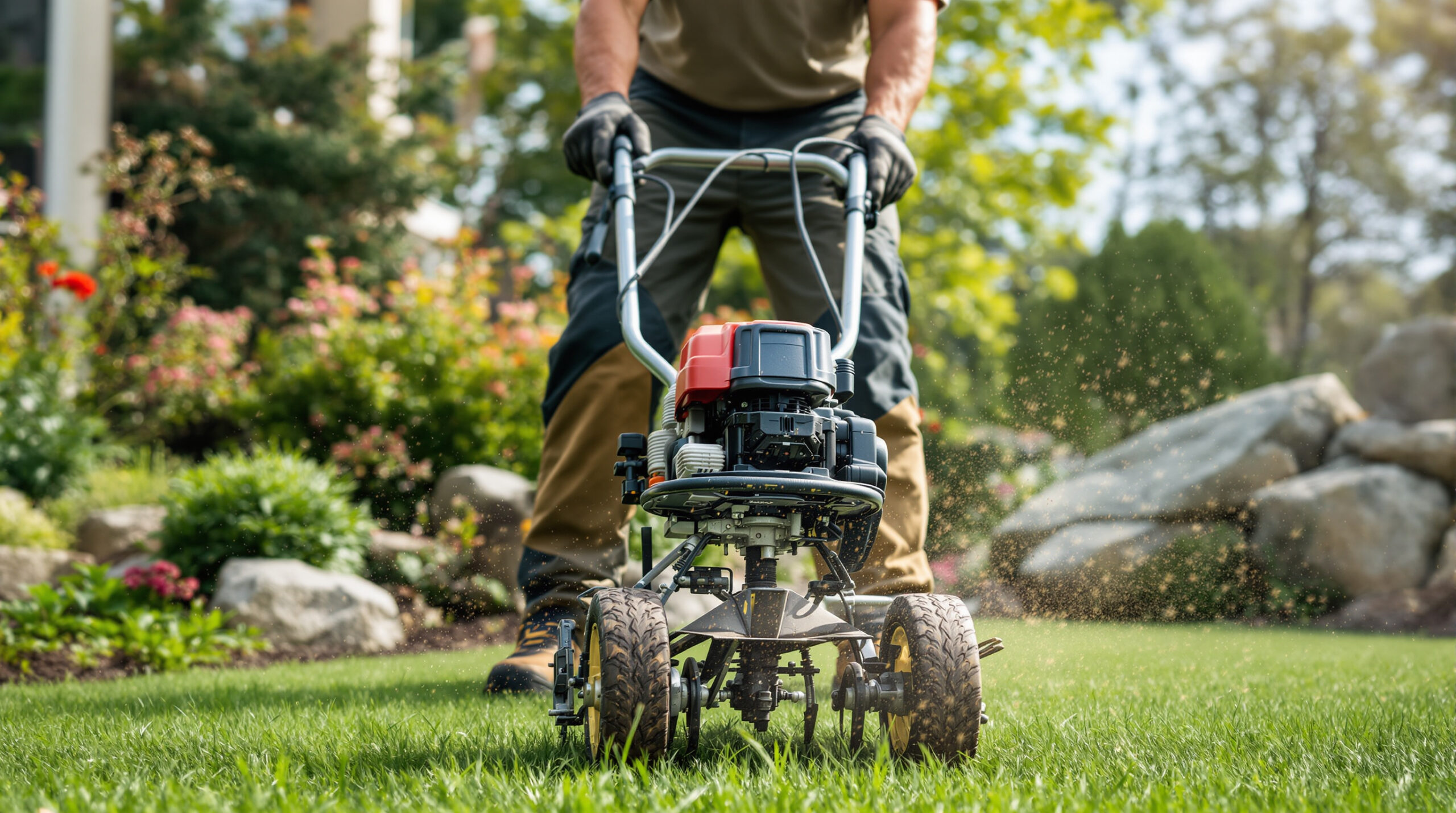
Core aeration involves removing small plugs of soil, typically 0.5 to 0.75 inches in diameter and 2 to 4 inches deep, across the entire lawn surface. This mechanical process breaks up compacted clay, allows oxygen and water to penetrate the root zone, and creates channels for organic matter to move deeper into the soil profile. For WNC lawns, aeration is not optional. It is the single most effective tool for improving water absorption in clay-heavy conditions.
When is the best time to aerate a WNC lawn?
Timing depends on grass type. Asheville’s cooler mountain climate supports predominantly cool-season grasses, especially tall fescue and Kentucky bluegrass blends. These grasses grow most actively from late August through November and again in March through May. Aerating in late August or early September, just before overseeding season, gives the lawn the best recovery window. Aerating during summer heat stress damages the grass and wastes the effort. Avoid aeration between June 15 and August 15 for cool-season lawns unless the weather has been unusually mild. If you’re planning major yard work around your aeration schedule, our guide to preparing your yard for spring construction in Asheville NC outlines how to sequence these tasks effectively.
How deep and how often should aeration happen in Asheville?
Annual aeration is the standard recommendation for compacted clay soils. Plugs should be pulled to a depth of at least 3 inches for meaningful impact. A single pass with a walk-behind core aerator covers the surface adequately for most residential lots. For lawns that have not been aerated in three or more years, two passes in perpendicular directions increases the number of holes per square foot from roughly 6 to 12, which meaningfully accelerates soil loosening. After aeration, top-dress with a quarter-inch layer of compost and water it in to start rebuilding organic matter immediately.
Does liquid aeration work as well as core aeration for heavy clay soil?
Liquid aeration products contain compounds that claim to break apart clay particles chemically. Current agronomic research, including studies from North Carolina State University‘s turfgrass program, does not support liquid aeration as a replacement for mechanical core aeration on heavily compacted soils. Liquid products may serve as a supplement between annual mechanical treatments but should not substitute for them. For Asheville homeowners dealing with genuine clay compaction, mechanical core aeration remains the evidence-backed approach.
Mulching: The Easiest Way to Cut Watering Frequency in Half
Organic mulch applied correctly to planting beds, tree rings, and exposed soil areas reduces surface evaporation by 50 to 70 percent according to data from the University of Georgia Cooperative Extension. In an Asheville summer where dry stretches between storms can last 10 to 14 days, that reduction translates directly into fewer watering sessions and healthier plant roots. Mulch is not just cosmetic. It is a functional soil management tool that pairs especially well with shade tolerant native plants suited to Asheville NC landscaping, which already require less supplemental water once established.
What type of mulch works best in WNC’s mountain climate?
Shredded hardwood mu