Key Takeaways
TL;DR: Asheville’s shaded mountain yards don’t have to be bare dirt and frustration. The region’s native flora includes dozens of shade-tolerant species that thrive in WNC’s clay-heavy soil, high rainfall, and steep terrain. Choosing the right plants cuts maintenance, supports local pollinators, and turns problem spots into standout features — especially when paired with thoughtful professional design.
- Asheville’s canopy-heavy lots create deep, partial, and dappled shade zones that each require different plant selections.
- Native species like wild ginger, trillium, and oakleaf hydrangea are adapted to WNC’s acidic, clay-rich soil and need far less intervention than non-natives.
- Shade-tolerant groundcovers reduce erosion on steep WNC slopes better than turf grass, which struggles without direct sun.
- Pairing native plantings with hardscaping elements like flagstone paths and retaining walls extends usability of shaded outdoor areas.
- Professional design prevents the most common mistake: choosing plants rated for partial shade that still burn out under dense tree canopy.
- Establishment watering and soil amendment during the first two growing seasons are critical for long-term native plant success.
- A phased planting plan typically costs vary depending on square footage, plant size, and site prep requirements — consult a local landscaper for a site-specific estimate.
Why Shaded Asheville Yards Are Both a Challenge and an Opportunity
Shade-tolerant native plants suited to Asheville NC landscaping can turn a frustrating, bare-dirt shaded yard into a layered, low-maintenance outdoor space that actually looks intentional. Asheville is widely recognized for its extensive urban tree canopy. Mature oaks, tulip poplars, hemlocks, and hickories cast the kind of shade that makes traditional lawn grass give up by July. Most homeowners either rake bare patches every fall and reseed with diminishing returns, or they just accept the moss and mud as their lot in life. Neither approach is necessary.
Western North Carolina sits at elevations ranging from roughly 2,000 to over 6,000 feet depending on the specific ridge or cove. That elevation range creates microclimates that shift dramatically within a single property. The north-facing slope behind your house might stay cool and moist all summer while the front yard bakes. The forest floor under your oak trees gets maybe 90 minutes of direct light on a good day. Understanding those microclimates is the starting point for any smart native planting plan. For more information on native plant ecology and selection, consult resources from your local Cooperative Extension Service or native plant society.
Reems Creek Outdoors has worked with shaded Asheville properties across Buncombe County and the broader WNC region, and the single most consistent finding is this: the yard that feels like a problem is usually a yard that hasn’t been matched to the right plant palette yet. Native shade plants aren’t a consolation prize. They’re a genuinely beautiful, ecologically rich, low-input alternative to fighting the conditions your trees create.
Understanding Asheville’s Shade Types Before You Plant Anything
Not all shade is the same, and planting the wrong species into the wrong shade type is the fastest way to lose money on a landscaping project. Asheville yards typically present three distinct shade conditions, and each supports a different range of native species.
What is the difference between deep shade, partial shade, and dappled shade?
Deep shade receives fewer than two hours of direct sun daily. It’s common under dense hemlock or beech canopies and on north-facing slopes. Partial shade gets two to four hours of direct sun, usually in morning or late afternoon. Dappled shade is filtered light through a canopy that moves with wind, giving plants shifting periods of light and shadow throughout the day. Most published plant tags use these terms loosely, so actual site observation over the course of a day matters more than label language.
How does WNC’s clay soil affect shade plant performance?
Buncombe County’s soil is predominantly Cecil and Pacolet series clays, which are acidic (pH typically 5.0 to 6.0), poorly drained when compacted, and dense enough to create anaerobic pockets around roots during heavy rain events. Native plants that evolved here are adapted to these conditions. Non-native imports often fail not because of shade but because their roots can’t handle the drainage and pH combination. For detailed soil guidance, refer to USDA Natural Resources Conservation Service resources. Soil amendment with aged pine bark, compost, and occasionally sulfur to drop pH further will support even the most demanding native species during establishment.
Does slope direction change which shade plants will survive on my property?
Absolutely. North-facing slopes in WNC retain moisture longer, stay cooler in summer, and create conditions closer to deep Appalachian cove habitat. South-facing slopes under tree cover can still get quite dry in summer because tree root competition draws down soil moisture fast. East-facing slopes get the gentler morning light that many shade plants prefer. West-facing slopes get intense afternoon heat even under partial cover. A site assessment should note compass orientation before any plant list is finalized.
The Best Shade-Tolerant Native Plants for Asheville NC Landscapes
Dozens of native species thrive under WNC’s tree canopy, but the list below represents the plants most consistently successful across varied Asheville site conditions, with specific notes on spacing, mature size, and soil preferences. For comprehensive native plant information, consult resources from your local Cooperative Extension Service or the USDA PLANTS Database.
Which native groundcovers handle deep shade without constant maintenance?
Wild ginger (Asarum canadense) is one of the top performers in deep shade under oaks and tulip poplars. It spreads slowly by rhizome to form a low mat, can suppress weeds as it establishes over several seasons, and requires no fertilizer once established. Green-and-gold (Chrysogonum virginianum) handles partial to dappled shade and produces bright yellow flowers from April through June. Creeping phlox (Phlox stolonifera) is another strong choice for partial shade slopes, spreading up to 18 inches wide per plant within two seasons. All three are drought-tolerant after the first full growing season.
What native ferns work for shaded slopes in Western North Carolina?
Ferns are arguably the most reliable shade solution in the Appalachian plant palette. Christmas fern (Polystichum acrostichoides) is evergreen, grows 18 to 24 inches tall, handles everything from partial to deep shade, and holds soil on slopes far better than grass. Cinnamon fern (Osmundastrum cinnamomeum) reaches 3 to 5 feet and thrives in consistently moist spots near downspouts or low-lying areas. New York fern (Thelypteris noveboracensis) creates a light, airy texture at 12 to 18 inches and spreads aggressively enough to fill large bare areas over time. Plant ferns 18 to 24 inches apart on center for full coverage.
Are there native flowering shrubs that bloom in full shade in Asheville?
Oakleaf hydrangea (Hydrangea quercifolia) is the standout native shrub for partial to full shade in WNC. It grows 4 to 8 feet tall and wide, produces large white flower clusters in June and July, and offers outstanding fall foliage and exfoliating bark for winter interest. Mountain laurel (Kalmia latifolia) blooms pink and white in May under dappled shade and is essentially iconic to Blue Ridge landscapes. Sweetshrub (Calycanthus floridus) handles deep shade, grows 6 to 9 feet, and its burgundy flowers have a subtle spice fragrance. Spacing for shrubs in a design context runs 4 to 6 feet on center depending on mature spread.
Layering Native Plants for a Naturalistic Shade Garden Design
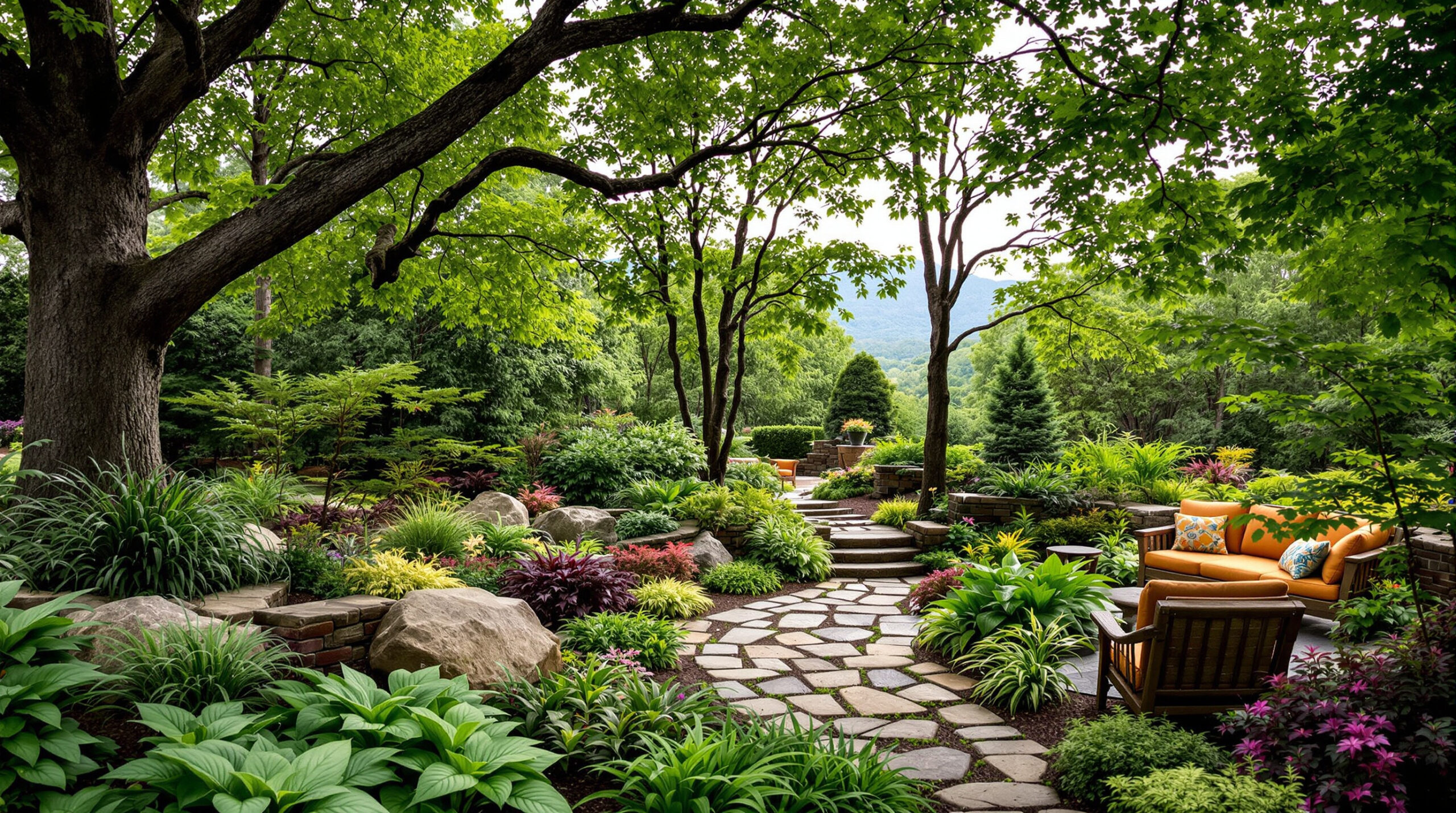
A layered planting design mimics the structure of an Appalachian cove forest and creates a yard that looks intentional rather than overgrown. The concept uses canopy, understory, shrub, herbaceous, and groundcover layers to fill every vertical zone with useful, attractive plants.
What does a layered native shade planting plan actually look like?
Start with the canopy you already have. Most Asheville properties don’t need additional canopy trees planted. Work down from there. Understory trees like serviceberry (Amelanchier arborea) and Eastern redbud (Cercis canadensis) fit the 15 to 25 foot zone and bloom early in spring when pollinators need it most. Below that, shrubs like sweetshrub and oakleaf hydrangea fill the 4 to 9 foot range. The herbaceous layer includes native perennials like black cohosh (Actaea racemosa), which reaches 4 to 6 feet in flower, and Solomon’s seal (Polygonatum biflorum) at 1 to 3 feet. Ground level gets the creeping species like wild ginger and creeping phlox. A planting plan that hits all five layers creates year-round visual interest with minimal gaps for weeds to fill.
How far apart should I space plants in a native shade garden?
Spacing depends on whether you want the area to look full in year one or year three. Planting at mature-spread spacing, typically 18 inches for groundcovers and 4 to 6 feet for shrubs, looks sparse initially but costs less and avoids transplanting later. Tighter spacing at 12 inches for groundcovers gives faster coverage but requires thinning once plants establish. A common professional approach is to use a combination of both strategies, planting shrubs at mature spacing and groundcovers more densely for quicker coverage.